
Table of contents
Early learning provides lifelong benefits
Better language skills, logical thinking and increased self-confidence
Even if children have not yet started school, or perhaps have just started, there are plenty of good reasons to give them an early learning foundation.
In the early years, children’s brains are particularly receptive to new impressions, patterns and linguistic nuances. This means that small, playful activities such as learning new words, discovering letters, hearing stories or exploring simple numbers create strong neural connections that make later learning easier and more intuitive.
Learning at a very young age is not about pushing the child, but about giving them the opportunity to explore the world with curiosity and in a safe environment.
Early learning has a lifelong effect. Children who are stimulated in preschool typically develop better language skills, increased self-confidence and a stronger understanding of the connections in their environment.
This makes them better equipped when they meet the demands of school, and it can give them a head start both academically and socially.
When you give children good learning experiences from an early age, you give them advantages not only in their start at school, but in their entire future.
Tasks and ideas for teaching children
Digital learning supports problem solving
Starting to learn at an early age can give your child a head start, both socially and academically. Children are like little sponges: they soak up new knowledge, especially when learning is made playful and exciting.
As a parent, you can use simple means to strengthen your child’s language, math understanding, and color and shape recognition already in preschool.
Below you will find ideas for tasks within each of these areas, so that your child can enjoy learning from the start. This includes both old-fashioned games and the latest digital learning via apps.

Early learning in a safe, playful atmosphere strengthens both language and social skills, later in kindergarten and school.
Early learning benefits your child
Academically, early learning can provide a gentle introduction to letters and numbers. Children who are introduced to language and math early on create a solid foundation that they can build on in kindergarten and school.
Research suggests that a rich vocabulary at a young age is linked to better reading skills later on. In other words: the earlier your child is stimulated linguistically and mentally, the more school-ready they will be.
As mentioned on our own Smart Minis front page, there are many ways to make screen time educational, for example through apps that combine play and learning.
Tip: While early formal education can be beneficial, it should still take place on the child’s terms. Learning through play, song and conversation is the way forward.
Below, we review the four core areas: language, math, colors and shapes, with ideas for tasks that are suitable for young children.

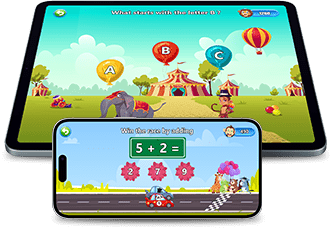
Make learning fun for your kid with the Smart Minis app for Android and iOS!
Packed with exciting educational games, your child will explore the alphabet, words, letters, math, shapes, and colors, all in a 100% safe, child-friendly environment.



Language and early introduction to reading
Vocabulary is built early
The first years of school will be much easier if your child already knows letters and has a basic vocabulary.
Language stimulation starts small. Point to things and put words to them in everyday life. When you are out shopping, for example, you can name fruits and vegetables or find things that start with a certain sound.
Books are also fantastic, both reading aloud and dialogic reading, where you talk about the pictures and the story along the way, will strengthen the child’s language. Bedtime reading several times a week is one of the best ways to teach the child how letters look, how words are put together and sentences are created.
According to educators and experts, children learn best when language learning feels like a game and not a duty.
Smart Minis has a language module in the app that uses spoken words, colorful illustrations and small games to introduce children to new words in a fun way. Games and tasks with letters
Games and tasks with letters
A classic exercise for the little ones is learning the alphabet through play.
Letter play can be singing the alphabet song, but it can also be something as simple as playing the classic game “I see something that starts with A!”.
A creative idea is to do drawing exercises. When you are learning the alphabet, it is effective (and fun) to draw the letters together. Give your child crayons and paper, and let them try to shape the shapes of the letters, for example a capital A like a tent with a window.
You can also cut out letters from cardboard and decorate them with glitter or stickers. This way the child gets the letters in their hands and remembers them better because they have not only glanced at them briefly.
Another fun language game is to make rhymes and rhymes. Make up silly sentences where all words begin with the same letter sound, “Sasha sings silly songs”, and see if the child can continue the series.
This trains the awareness of sounds in words (phonological awareness), which is important when the child later has to crack the reading code.
Digital aids can also work wonders. Apps with stories, sounds and pictures, such as the Smart Minis app, can motivate the child to play with language. In the app, the letters are read aloud and linked with pictures, which naturally connects text and speech.
The child experiences learning new words, almost without noticing that they are “practicing”.
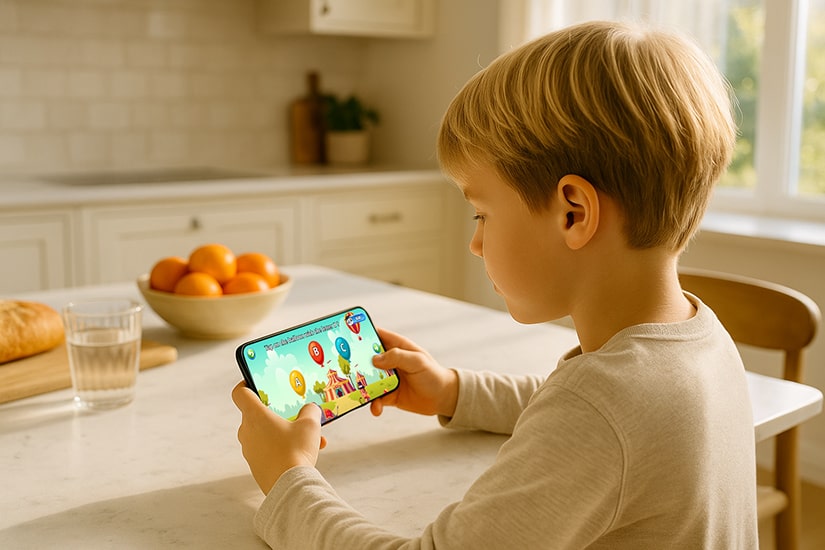
The letter game shown is from the educational app Smart Minis.
Math game for the little ones
Basic number sense
Young children encounter numbers everywhere: the number of candles on a birthday cake, the number of teddy bears in bed, mom and dad live on the 3rd floor. You can cultivate this curiosity by integrating numbers into everyday life.
Count the stairs up to the front door together, count the chairs in the kitchen, or sort Lego bricks by number and color.
Children learn through their senses, so seeing and touching things while counting makes abstract numbers more concrete.
As early as the age of 2, many children can learn to count to 5 through repetition and play. In kindergarten, you can gradually start playing with simple addition pieces: “You have 2 apples and get 1 more, how many do you have?”
The whole point is not to pressure the child, but to show that numbers are fun and meaningful.
Fun math games in everyday life
There are a lot of games that train mathematical concepts without looking like boring teaching.
Sorting games are obvious. Ask your child to sort their teddy bears by size, big teddy bears for themselves and small teddy bears for themselves.
You can also practice concepts like most/least by making two piles of Lego bricks and asking which pile has the most. Feel free to count together to confirm the answer.
When you eat, you can play “How many carrots do we each have?” and that way practice dividing and counting.
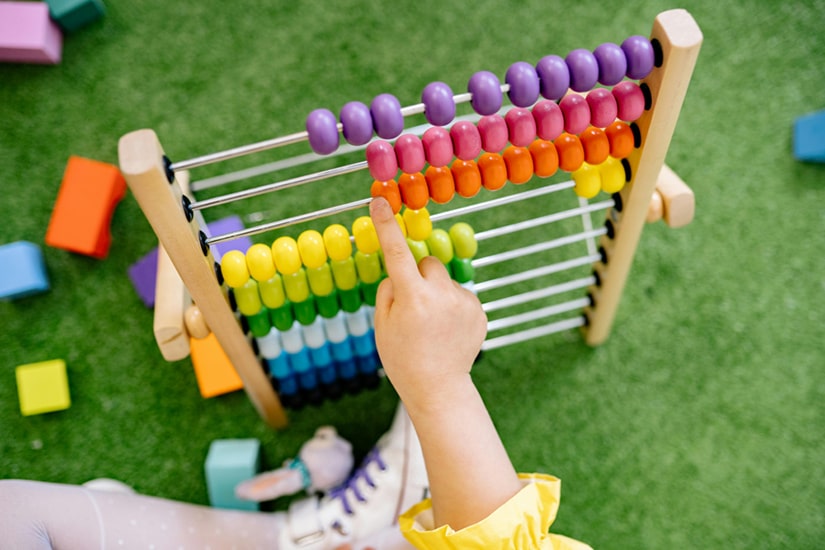
A child uses a colorful ball frame to practice counting. Physical aids like this make abstract numbers more concrete and tangible
Games and concrete tools make math games even more fun. A ball frame or counting strip with beads lets the child move beads while you count out loud, so the child can see, hear and touch the numbers.
Board games for the little ones, where you have to roll a dice and move your piece the corresponding number of spaces, are also really good. The child practices number recognition on the dice and learns simple plus pieces by counting out spaces.
On the Smart Mini math page, you can see mini-games that contain plus and minus in a playful way, for example by having numbers and calculations read out loud while the child solves small problems.
This combination of sound, sight and interactivity strengthens the child’s understanding of quantities and calculations without any pressure.
Tip: Also use tangible objects for math games. Crackers, raisins or blocks can be stacked and handed out so that the child can visually follow small plus and minus pieces. This makes math relevant and fun!
Make learning fun for your kid with the Smart Minis app for Android and iOS!
Packed with exciting educational games, your child will explore the alphabet, words, letters, math, shapes, and colors, all in a 100% safe, child-friendly environment.
Learn colors through play
Colors in everyday life
Color recognition is one of the first cognitive skills that children typically develop. As early as the age of 2, many can begin to distinguish between the basic colors red, yellow, green, and blue.
You can help the process along by consistently putting words to colors in everyday life: “Look at the yellow bus,” “Do you want to wear the red or blue shirt?”
Make it a game to find certain colors in the environment. For example, on a walk, you can say “Now it’s time to spot something green!” and your child may eagerly point to a green sign or a bush.
Children learn best when they are actively included, and such a color hunt makes learning a fun challenge.
Games that train colors
A simple but entertaining activity is color sorting. Find some colored cups or bowls and let your child sort LEGO bricks or beads in them by color.
This develops both color recognition and fine motor skills. You can also paint and draw your way through the colors. Focus on one color at a time, “Today we only paint with yellow!”, and then draw lots of suns, flowers and lemons. Talk about shades (“lighter yellow”, “darker yellow”) to expand the child’s conceptual world.
Another idea is to make a color memory game. Cut squares of colored paper (two of each color), mix them up and place them on the table with the color facing down. Now the child should turn over two cards at a time and try to find color pairs. This classic game trains memory at the same time as color recognition.
There are also good digital solutions. On the Smart Mini shapes and colors page you can see examples of games where the children have to choose the right colored object or play with a musical rainbow.
The digital games reward the child with fun sounds and animations when they get it right, which creates motivation and makes learning fun.
Tip: Use everyday routines for color training. For example, when brushing your teeth, ask: “What color is your toothbrush?” Or ask your child to find all the red things in the room when cleaning up. Then even cleaning up becomes a color game!
Recognize shapes in everyday life
Introduction to different shapes
Shapes are everywhere around us and children notice them early on if we guide them.
Point to the moon and explain that it is round like a circle; windows can be square like squares; a road sign can be triangular. When you eat toast or a sandwich, cut it into a triangle and say “now you have a triangle food!”.
By linking the shapes to concrete objects, the child remembers them better. The basic shapes circle, square, triangle and star can be introduced with pictures and by drawing them together.
Also use the child’s own body: “Can you make a circle with your arms?” and suddenly learning becomes physical play.
Activities with figures and puzzles
Many games and toys stimulate shape recognition quite naturally. The classic is shape puzzles or nesting boxes, where the child has to put the round brick in the round hole, the square brick in the square hole, etc.
At first, the little ones may try all the holes randomly, but over time they learn to recognize which shape fits, it’s a fantastic exercise in both shapes and problem solving.
Praise your child when they succeed: the positive feedback strengthens motivation.
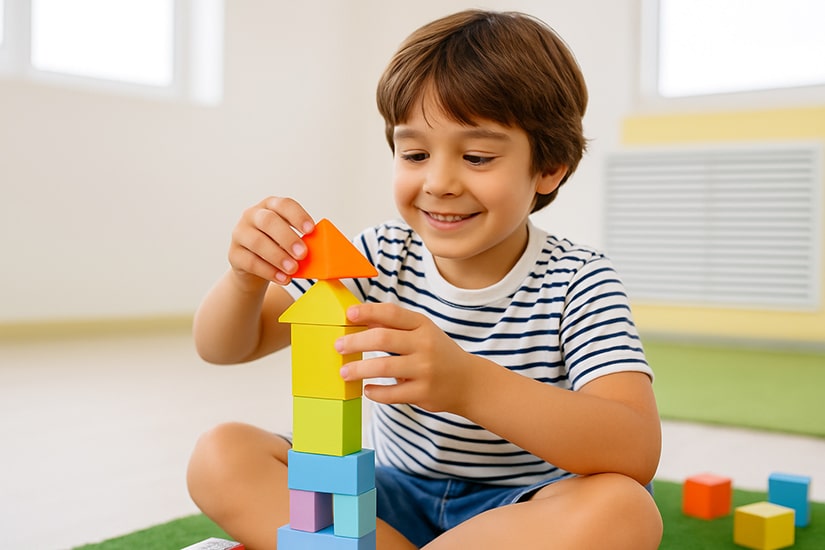
Through construction with blocks, children learn about different colors and shapes
Building blocks are generally excellent for learning about shapes. As a parent, you can play along by mentioning the shapes along the way: “Should we put the cylinder-shaped block on top of the cube-shaped one?”, so children learn the concepts without it feeling like boring homework.
Puzzles with large pieces (preferably with simple shapes) also teach the child to match shapes and develop eye-hand coordination. You can start with stud puzzles, where the shape of the piece clearly matches a hole. Later, you can try memory games with shapes or more complex puzzles.
As with the other areas, there are digital games that can supplement. In the Smart Mini universe, children are rewarded, for example, for recognizing a triangle or a square in play and they can draw the shapes on the screen, which combines visual and practical learning.
Regardless of the medium, the key word is to have fun. When learning about shapes becomes a game, your child develops new skills all by itself.
Tip: Talk about shapes when you draw together. Draw a snowman (circle on circle), a house (square with a triangle roof) or a star in the night sky. The child discovers that the shapes are not abstract and they become recognizable things from everyday life.
Make learning fun for your kid with the Smart Minis app for Android and iOS!
Packed with exciting educational games, your child will explore the alphabet, words, letters, math, shapes, and colors, all in a 100% safe, child-friendly environment.
Conklusion
Learning through play, also with digital aids
When you teach your little one at home, it should feel cozy and playful. Children learn best when they don’t notice that they are learning something. That is why many of the suggested tasks are about sneaking learning into play, singing, drawing and everyday situations.
As a parent, you are your child’s first and most important teacher, and your enthusiasm is contagious. If you make it a game to find colors, count steps or shape letters in modeling clay, your child will welcome learning with open arms.
Also remember that we live in a digital age and screen time can certainly be educational.
There are now several good apps and games aimed at 2-7 year olds that combine entertainment with learning. Apps with tasks in language, mathematics, colors and shapes in particular are good tools to supplement physical games.
For example, the Smart Minis app offers a wide range of mini-games that support early literacy skills, introduce plus and minus, and let children practice color and shape recognition in an interactive way.
On the Smart Minis math page and the shapes and colors page, you can see how game elements and reward systems motivate children. Every time a task is solved, the child is greeted with positive feedback and points that can be used to buy a small virtual gift for their character in the game. Something like that can really put a smile on the little ones’ faces and make them eager to learn more.
Finally, the most important thing is to have fun together along the way. Your child will love the quality time you get when you draw letters, build towers, or sing counting songs.
And while the game is going on, you can be sure that you are preparing your child for school life in the best possible way, namely through security, play, and presence.
Enjoy learning… and playing!