
Table of contents
Reading is at a low point
1 in 4 children are not ready for school
In surveys of younger students, only about 14–17 % of U.S. 13-year-olds reported reading for fun almost every day in recent years, a level that’s substantially lower than earlier decades.
According to the National Survey of Children’s Health, one-third (about 33%) needed support related in school readiness, including early learning skills, social-emotional development, and early literacy.
U.S. national reading assessments show many children struggle with basic reading skills later on: in 2024, about 40% of fourth graders and roughly one-third of eighth graders scored below the “basic” reading level on the NAEP “Nation’s Report Card”, reflecting broader issues in literacy development.
These figures suggest that some children either lack sufficient reading skills or have simply never experienced the joy of reading.
The result is that some children will struggle more with reading in school than necessary, and this can have an impact on their entire schooling and desire to learn.
Why is reading important for a child’s development?
Reading develops the human being
The ability to read and understand language is the foundation for all other learning. From science to mathematics, if the child cannot read the assignment or the textbook, it becomes difficult to acquire knowledge.
Educators and researchers frame this as a serious literacy concern, pointing out that around 40 % of fourth graders and 33 % of eighth graders perform below basic reading levels. It is the highest levels in decades, and a sign that many students struggle with foundational reading skills.
Reading is not just a school skill; it is a life skill. Through books and stories, children develop imagination, empathy and the ability to concentrate.
Children learn new words and concepts almost without noticing it, and a rich vocabulary at a young age is linked to better reading skills later on.
In other words: the earlier we stimulate the child’s language, the better equipped they will be.

Reading aloud at bedtime provides familiarity with books and stories from an early age.
Reading strengthens language learning
Research also points to a clear connection between early language skills and later school performance.
In the United States, longitudinal studies similarly show that early oral language and vocabulary skills are strongly linked to later school performance.
For example, children’s vocabulary size at age 2 has been shown to predict language and literacy outcomes into elementary school, and preschool vocabulary levels are associated with reading and math achievement by the end of kindergarten.
Children with smaller vocabularies early in life are at increased risk of lower reading scores later in school, highlighting the importance of vocabulary development as a foundation for academic success.
Language and reading are closely linked to children’s general development, both academically and socially. Children who are stimulated linguistically from an early age typically develop stronger communication skills, greater self-confidence and a better understanding of the context in their world. In short, children become more ready for the challenges of school and have a head start that can last a lifetime.
It’s not about pressuring children to read before they are ready, but about giving them the opportunity to explore language in a safe and fun way from an early age.
The brain is particularly receptive in the early years, so games and activities with words and letters create strong neural connections that make later learning easier.
In short: Early reading, on the child’s terms, is a gift that benefits far into the future.

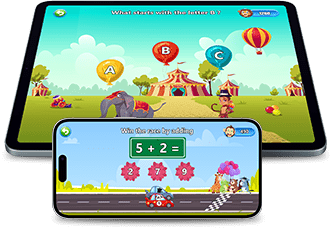
Make learning fun for your kid with the Smart Minis app for Android and iOS!
Packed with exciting educational games, your child will explore the alphabet, words, letters, math, shapes, and colors, all in a 100% safe, child-friendly environment.



What can parents do to improve reading skills?
Make learning fun and playful
As a parent, you are your child’s first and most important teacher. You can make a big difference to your child’s reading development through small daily actions.
The key is to make reading and language a natural part of everyday life and to make it fun!
Let’s look at some strategies you can use to promote a love of reading and early literacy skills.
Make reading a cozy time
One of the best ways to spark your child’s interest in books is through reading aloud. Create cozy times by sitting down together, perhaps before bedtime, and read a bedtime story several times a week.
Children love the ritual of bedtime reading, and it strengthens both language and the bond between you.
Through books, the child learns what letters look like, what words sound like, and how sentences are formed.
Make reading aloud interactive by talking about the pictures and the action along the way. This is called dialogic reading and increases the child’s understanding and vocabulary.
When you read about, for example, a cat, ask: “Can you point to the cat? What do you think the cat is doing now?” These little conversations make reading more vivid and engaging.
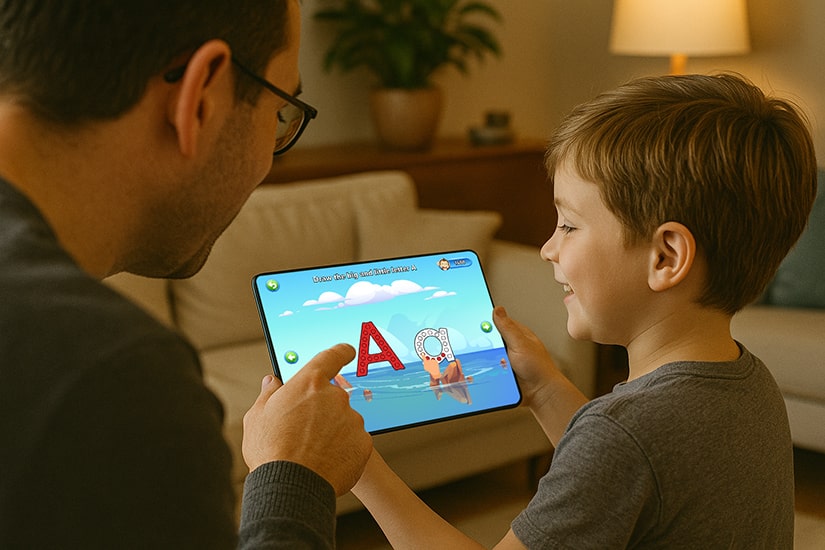
Parents can do a lot to strengthen their child’s language, including by drawing and writing letters together and playing word and sound games in everyday life. Here, letters are drawn in the Smart Mini app.
Use language in everyday life
It is also important to integrate language into everyday life. Talk to your child about everything.
Point to things around you and put words to them. For example, on a shopping trip, you can point out fruits and vegetables and say their names. You can also play “Who sees something red first?” or “Can you find something that starts with M?” when you go for a walk.
Games like this train the child’s attention to the sounds and letters of the language without it feeling like a task.
Educators and experts emphasize that children learn language best when it feels like a game and not a duty. The more you can associate reading with fun, play and presence, the more positive the child will experience it.
Play with letters and sounds
Teach your child the alphabet in a fun way
Children love to play, so why not play with the alphabet? There are many fun letter games for the little ones. You can sing the alphabet song together. Music and rhythm make it easier to remember the order of the letters.
A creative activity is to draw or paint the letters. Give your child crayons or paint, and make a fun activity out of forming letters on paper. You can draw a capital “A” and turn it into a drawing of a tent with a door, or draw freely and see if you can find letters in the things you have drawn.
When your child draws or paints the letters themselves, they get the letters “in their hands” and remember them better than if they just see them in a book or on a screen.
You can also cut letter shapes out of cardboard and decorate them with glitter and stickers, all of which are activities that make the alphabet tangible and exciting.
Teach your child the alphabet in a fun way
Playing with the sounds of language is another good exercise. Try making up funny little rhymes and rhymes together. You can make silly sentences where all words begin with the same letter sound, for example, “Mike making merry music”, and see if the child can continue with the next sentence.
This kind of play strengthens phonological awareness, i.e. the child’s ear for the sounds in words, which is crucial for cracking the reading code later on.
Patience is a virtue, so follow your child’s pace rather than having a specific goal. Every child learns differently, so even if your friend has a different experience than you with their child, it doesn’t mean that their experience will work for you.
It is much more important to create a positive experience around reading. If the child associates books and letters with pleasant times with mom and dad, the motivation to learn will come quite naturally. As a bonus, you as a family will have many good laughs and memories along the learning journey.
Digital learning apps can make reading more fun
We live in a digital age, for better or worse, where tablets and smartphones quickly capture children’s attention.
Too much screen time can worry parents, but digital aids can actually be a valuable supplement to the traditional book, if used correctly.
Experts point out that the right kind of digital learning through apps can strengthen children’s early development.
Quality learning apps for 2-7 year olds can combine play and learning, so that screen time becomes meaningful rather than passive.
Apps with a focus on language and early reading in particular can give children an extra boost because they present letters and words in an interactive and playful way.

Apps play a big part in children’s lives today, but they can also be used actively to learn letters, words and numbers in a way that feels like play.
Learning apps can be powerful teachers
When children use a good learning app, they get immediate feedback and rewards, which increases their joy and motivation. For example, many apps will praise the child or give points when they solve a task correctly.
Such gamification makes the child eager to try again and learn more. At the same time, apps can do something that books cannot: they combine sound, images and interactivity and make learning come alive.
You can make the letters move on the screen, hear them pronounced, and perhaps draw the letter yourself with a finger.
This combination of visual, auditory and practical learning provides a stronger understanding of language.
When a child sees a word on the screen and hears it read aloud at the same time, they naturally learn to connect text with speech, which is the cornerstone of learning language.
The next step is for your child to try writing the letters themselves, which can be illustrated in an animation in an app before they try themselves. In this way, they also strengthen fine motor skills and letter recognition.
Make learning fun for your kid with the Smart Minis app for Android and iOS!
Packed with exciting educational games, your child will explore the alphabet, words, letters, math, shapes, and colors, all in a 100% safe, child-friendly environment.
Your learning tool for teaching languages
Smart Minis app for Android and iOS
A good example of a great educational app is the Smart Minis app.
It is a brand new learning app, tailored for the youngest 2 to 7 years old, built using well-known and proven learning tools.
The Smart Minis app combines playful interaction with effective language and learning tools. The app even contains several learning modules, so that not only language is taught, but also math, colors and shapes.
In the app’s language module, words and letters are presented with colorful illustrations and read aloud, while small mini-games let the child practice by hearing pronunciation and strengthen sound recognition.
The app also makes alphabet learning easy by letting the child draw the shape of the letters with their finger, so that they get the feeling of writing themselves.
For each correct answer, the child is rewarded with points and praise. The points can be used to buy fun clothes and food for a virtual playroom, which they choose the first time they start the app. By having a playmate, they feel more motivated as they receive constant feedback on both correct and incorrect answers.
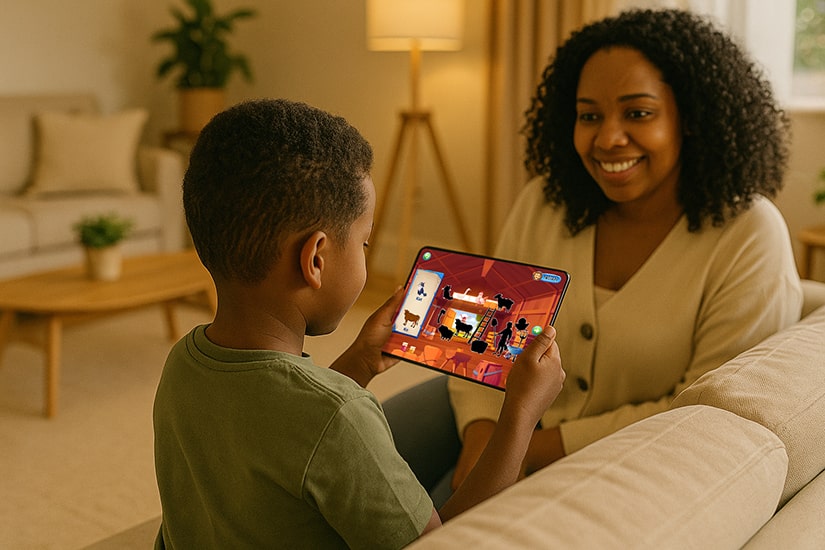
The combination of games, pictures and sound in the app makes learning words exciting. In the Smart Mini app, children can also learn about math, colors and shapes.
In addition to language, your child can also learn math, colors and shapes in the app
As mentioned, the Smart Minis universe covers not only language and reading, but also numbers, math, shapes and colors through playful activities. On the Smart Minis math page and the shapes & colors page, you can, for example, see how games and reward systems are used to motivate children to learn more.
The app is 100% child-safe, without ads or hidden fees, so you can safely let your child explore and learn in the digital universe.
A learning app to help
With digital learning tools like the Smart Minis app, parents have another way to engage their children in learning.
It is not intended to replace good, old-fashioned books or your shared reading sessions, but it can supplement and replace less educational apps like YouTube or other pastime games.
Children can quickly get bored of solving tasks on a piece of paper, but are quickly captured by the entertaining and playful way the tasks are presented in a learning app. And suddenly they have learned new words and letters, almost without realizing it.
Make learning fun for your kid with the Smart Minis app for Android and iOS!
Packed with exciting educational games, your child will explore the alphabet, words, letters, math, shapes, and colors, all in a 100% safe, child-friendly environment.
Conclusion
Play and learn the traditional way, but now also with learning apps
So, do children read well enough? The answer is that they can, especially if we as parents support them in the right ways.
Children today live in a world full of screens and digital entertainment, but by making learning a game we can turn this to their advantage.
By starting early with reading books, playing with language and using modern aids, we can both increase children’s reading pleasure and their skills.
Smart Minis’ learning app is an example of how traditional learning and digital play can go hand in hand. Here, children learn words, letters, numbers, shapes and colors in a fun and interactive way, and parents can rest assured that the content is educational and well-researched.
Regardless of which path you choose to teach your child, the most important thing is to make it fun.
Your child will love the quality time you get when you draw letters, read stories or play learning games together.
Through security, play and presence, you prepare your child in the best possible way for school life. And there is hardly any better sight than a child’s eyes that light up when they learn something new, whether it is the first word they read aloud themselves, or a new level in a learning app that is completed.
Happy reading and have fun!